

You calculate resignation notice period in Malaysia from the employee’s length of service, using either the notice period stated in the employment contract or, if the contract is silent, the statutory minimum under the Employment Act 1955, 4 weeks under 2 years of service, 6 weeks for 2 to 5 years, and 8 weeks for 5 years or more. Notice is counted in calendar days, not working days, and either side can pay in lieu of notice instead of serving it out. This guide walks through the statutory tiers, how to calculate the exact notice period or pay-in-lieu amount, and what to do when the contract specifies something different.
What Is the Statutory Notice Period in Malaysia?
Statutory notice period in Malaysia is the minimum notice the Employment Act 1955 requires, based on how long the employee has worked for you, and it applies by default whenever the employment contract does not specify its own notice period. There are three tiers, and the applicable tier depends only on length of service, not on why the employment is ending.
- Less than 2 years of service: 4 weeks’ notice.
- 2 years but less than 5 years of service: 6 weeks’ notice.
- 5 years of service or more: 8 weeks’ notice.
These are minimums, and they apply equally whether the employee is resigning or the employer is terminating. If the employment contract specifies a longer or shorter notice period, the contract term generally governs instead, see the section below on contractual notice periods.
How Do You Calculate the Exact Notice Period in Days?
You calculate the exact notice period by counting forward in calendar days from the date notice is given, not working days, and the count does not pause for weekends or public holidays.
For example
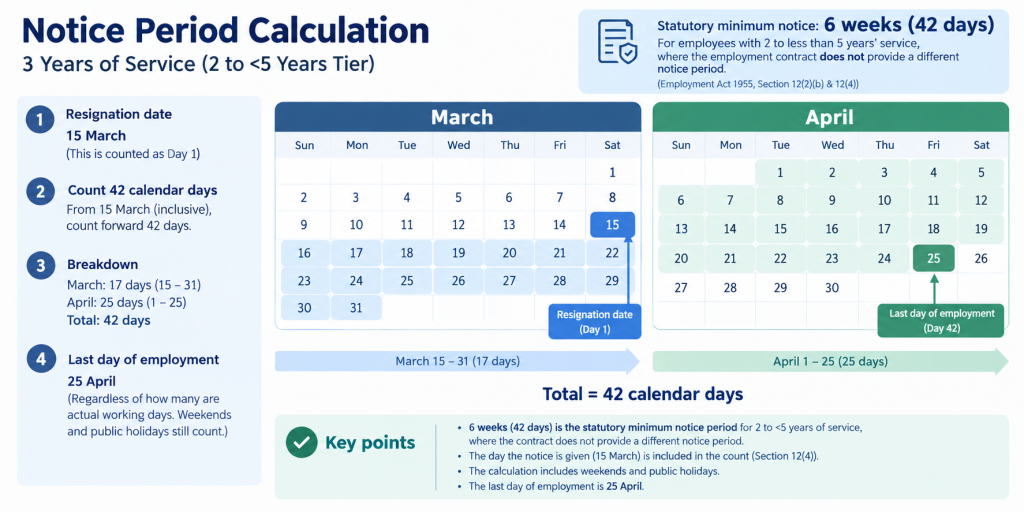
An employee with 3 years of service falls into the 2-to-5-year tier, so their statutory notice period is 6 weeks, which is 42 calendar days. If they hand in their resignation on 15 March, count 42 calendar days forward, starting with 15 March itself as day 1: that covers the remaining 17 days of March (15 to 31) and 25 days of April (1 to 25), for 42 days total, ending on 25 April. Their last day of employment is 25 April regardless of how many of those 42 days were actual working days, weekends and public holidays inside the window still count.
How Do You Calculate Pay in Lieu of Notice?
Either the employer or the employee can choose to pay in lieu of notice instead of serving it, meaning the employee leaves immediately and the paying party covers the equivalent salary for the notice period instead. Because notice periods almost never align neatly with calendar months, the payment is usually prorated by calendar days in each month the notice period spans.
For example
Take the same employee: 6 weeks’ notice starting 15 March and ending 25 April, on a monthly salary of RM4,000. The notice period spans 17 days in March (15 to 31 March) and 25 days in April (1 to 25 April).
March portion: RM4,000 x (17 / 31 days in March) = RM2,193.55.
April portion: RM4,000 x (25 / 30 days in April) = RM3,333.33.
Total pay in lieu of notice: RM2,193.55 + RM3,333.33 = RM5,526.88. The same day-count method applies whichever party is paying in lieu.
What If the Employment Contract Specifies a Different Notice Period?
A contractual notice period that is equal to or longer than the statutory minimum is valid and takes precedence over the Employment Act’s default tiers. A contractual notice period that is shorter than the statutory minimum is not enforceable, the statutory minimum still applies regardless of what the contract says. This is why getting the notice clause right when drafting or stamping the employment contract matters, an unenforceable notice clause creates confusion for both sides at the point of resignation.

Can an Employer Waive the Notice Period?
Yes. An employer can waive some or all of an employee’s notice period as goodwill, this does not obligate the employer to pay for the waived portion unless the two parties agree otherwise. Any waiver should be confirmed in writing, including the agreed last working day and whether payment for the waived notice applies, to avoid disputes later.
Conclusion
Calculating resignation notice period in Malaysia comes down to two checks, what the employment contract says and if it is silent or unenforceable, which statutory tier the employee’s length of service falls into. From there, notice runs in calendar days, and pay in lieu is prorated the same way if either party chooses not to serve it out.
Need help getting an offboarding or notice period calculation right? Contact Trust Recruit today for a free consultation on employment compliance. Get your free consultation now
Frequently Asked Questions
Use the notice period in the employment contract if it meets or exceeds the statutory minimum, otherwise apply the Employment Act 1955 tiers, 4 weeks under 2 years, 6 weeks for 2 to 5 years, 8 weeks for 5 years or more.
Calendar days. The notice period runs continuously from the day notice is given and does not pause for weekends or public holidays.
Prorate the employee’s monthly salary by the number of calendar days the notice period covers in each affected month, then add the portions together.
No. A contractual notice period shorter than the statutory minimum is not enforceable, the statutory minimum still applies.
Yes, an employer can waive some or all of the notice period, this should be confirmed in writing along with whether payment for the waived portion applies.
No, the same statutory tiers apply to both employer-initiated termination and employee resignation.